
At Bladon

Richard himself received another 500 requests for the poem by Avril Anderson which he read at the conclusion of his commentary:

… the village of Bladon, just two miles from Blenheim where the lychgate of the church and the tower of the church can be seen on a winter’s day. It’s close by this church and this churchyard that the Spencer-Churchills lie buried. Not in any lordly isolation, but buried with them down there, John Harry Adams, and Percy Merry, and Kathleen Jones, and William Partlitt, and John Abbott, and Arthur Sawyer, and two little unnamed children aged six and seven. The church itself is as simple and unpretentious as are the graves that lie by it. These the graves of the Churchills – this the grave of Winston Churchill. It lies next to the place where his mother, whom he said was to him like the Evening Star, is buried under those plants that grow. This is the cross of the grave of his father, Lord Randolph Churchill. And all this lies within sight of the monumental palace of Blenheim that a grateful Sovereign gave to Winston Churchill’s ancestor for his services to England, the huge house where Sir Winston said that he took two important decisions – ‘to be born and to marry, and I did not regret either’. Here as a boy he played. As a young man he took the train to Handborough, and a lift on the estate cart up to the Palace. Here he returned in the days of his fame. Here they bring him today to lie forever.
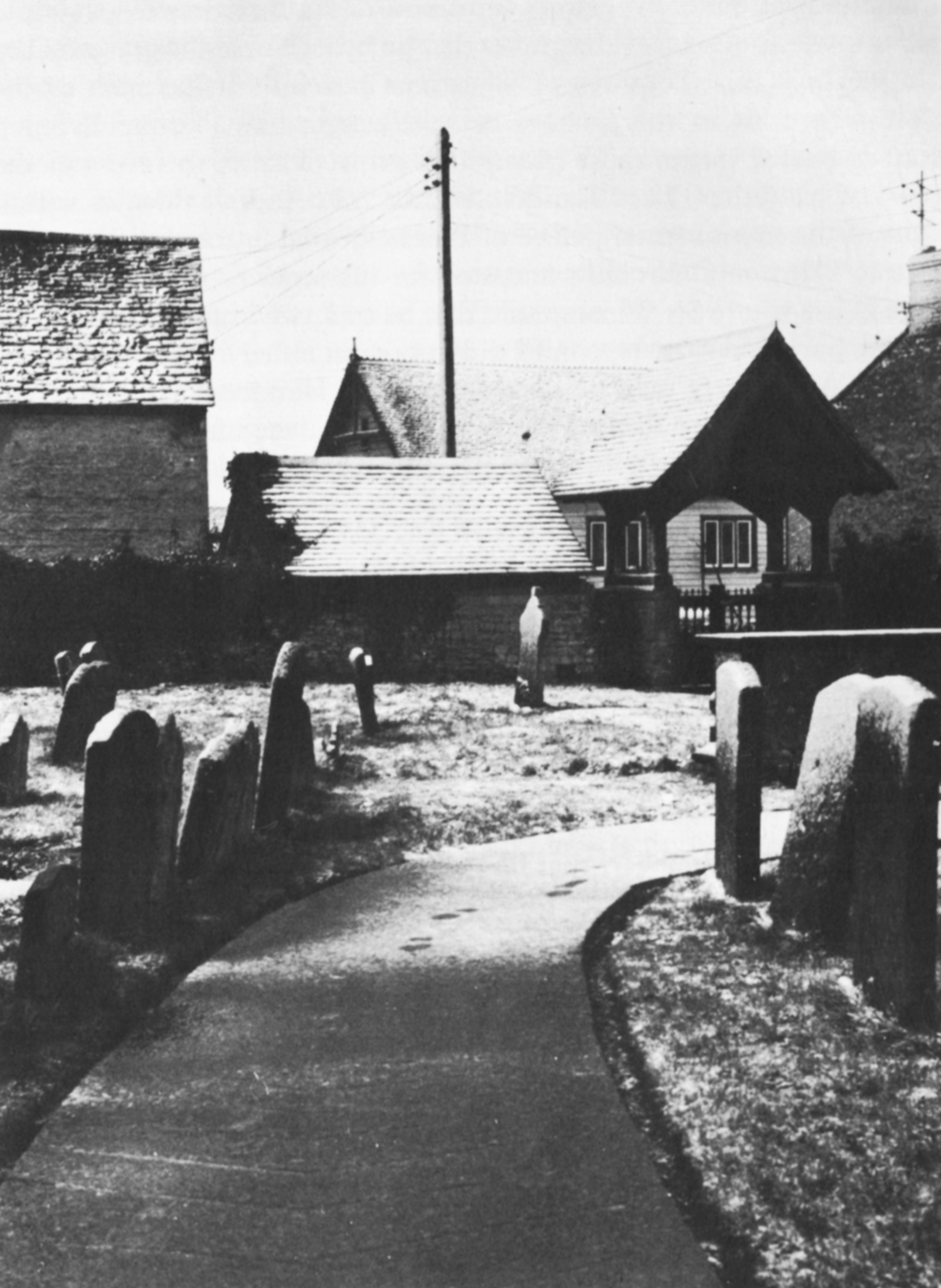
A snowy churchyard

From the Hall of Kings they bore him then,
The greatest of all Englishmen,
To the nation’s, the world’s, requiem
        At Bladon.

Drop, English earth, on him beneath,
To our sons and their sons bequeath
His glories, and our pride and grief
        At Bladon.

For lionheart that lies below,
That feared not toil, nor tears, nor foe,
Let the oak stand, though tempests blow
        At Bladon.

So Churchill sleeps; yet surely wakes,
Old warrior, where the morning breaks
On sunlit uplands – but the heart aches
        At Bladon.
The Private Interior Truth

That broadcast was recalled a year later in the television column of ‘New Christian’:

You don’t love a man because he’s a professional: you tend, rather, to distrust him, particularly if his professional expertise is directed towards the projection of an image which sometimes seems too gentle to be true.

But people did love Richard Dimbleby and I for one am not ashamed to acknowledge that I was, and remain, one of them. And since I think the roots of my affection for him have a general significance in terms of the whole medium of television I have decided to explain why.

I think it was because he was a person. Television is a medium which eats people. It builds a man into an image: instant soft and desirable female or instant rugged masculinity, always there for screening and plugging and satisfying the aching unconscious needs of the viewer. And if the image goes wrong or the glitter wears a bit thin then the tele-magnates smash the image, drop the idol and start all over again with somebody else. Television is no respecter of persons: it has become, rather, a machine to destroy the person in place of the transient image.

But Richard Dimbleby lasted. I think this was because he was one of those people in whom the public image was the private, interior truth. He really believed what he said on Panorama. He was unbearably open at moments when lesser men, image-mongers, dissolved into fantasy or fiction. And because he brought only himself to the screen, never a self tarted up to represent the kind of person which viewers or listeners might find desirable, it was because he was himself that you trusted him.

I know he had a lot of qualities which some people found rather plummy, his occasional tendency to cross the boundary from the factual to the magisterial, his incredible unflappability, his open devotion to Queen and Country: but these qualities were aspects of a composite person. They were never caricatures, designed cunningly for effect or viewer appeal. They were part of him. And they were complementary to other qualities which are, perhaps, even less fashionable in modern society – gentleness, patience, respect and charity.

There have been moments in all our lives which have been appreciated and savoured and made history by Dimbleby. I think his great occasion for me will always be his commentary on the funeral of Sir Winston. Here was a figure out of history, an old lonely man going to his long home and taking with him something of the glory of England. You might say that in his death England saw a final end to the dangerous myth of her superior moral authority in a wicked world. Dimbleby did not show it to us like that: he reminded us Churchill was a man, and when, in the closing minutes of that January afternoon, he talked of Bladon and the old men and maidens, young men and children, among whom in English soil Winston would soon be laid to rest, you could hear that Dimbleby himself was openly crying.

He must have known he himself was dying then. In losing him at the end of a year of national bereavement we lost a friend whose wisdom and quietness will linger with us as a reminder that we each have it in us to be a person and that the person, not the image, is holy.

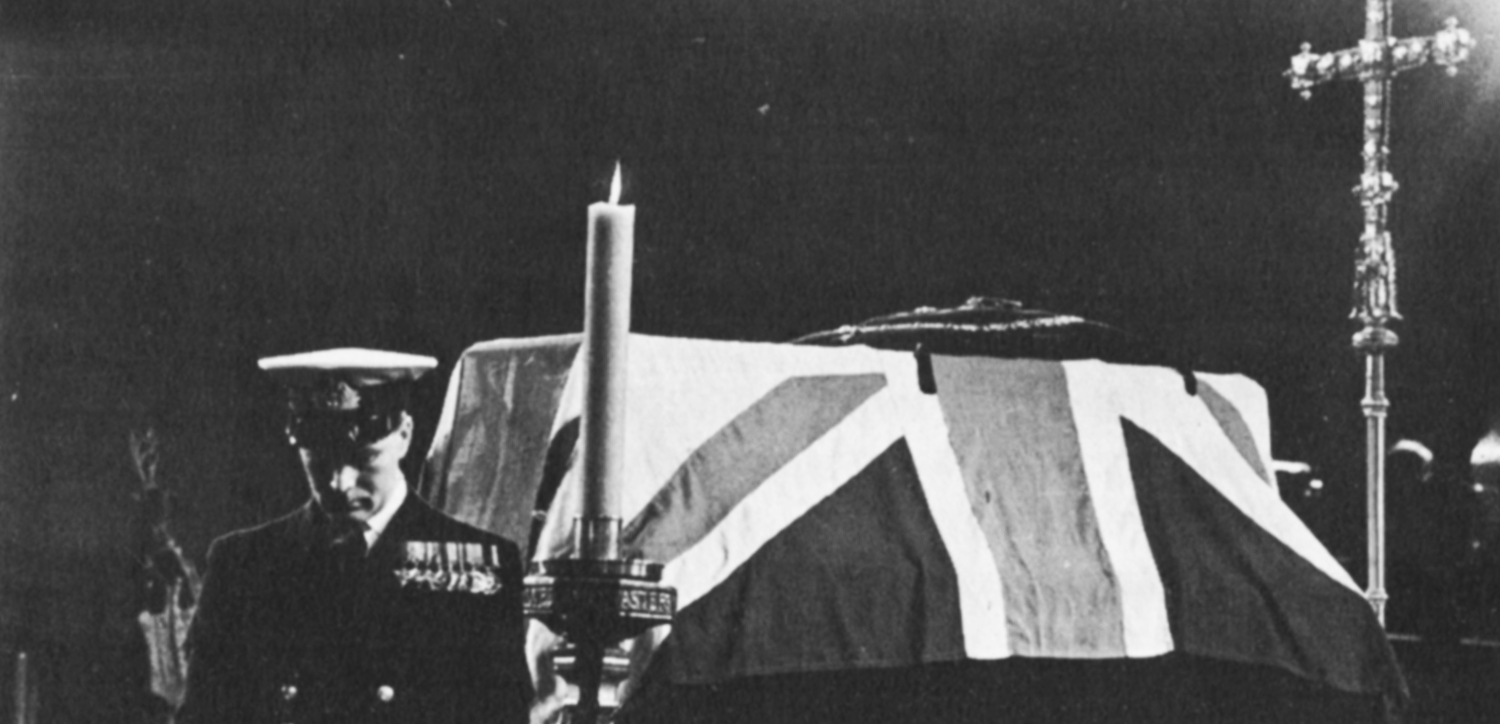
A man in uniform bows his head with Churchill's coffin inn the background
‘All the services share this sombre honour’