S. J. de Lotbinière set up the BBC’s War Reporting Unit.
The BBC had told the War Office that the invasion of Europe would need a team of war correspondents who by their number could cover the frontline activity as well as Headquarters briefings. Newspapers were restricted by the tradition of ‘one newspaper, one correspondent’ in any theatre of war, and we were challenged to prove our case for a large team by taking part in a big Second Front exercise which took place in the Home Counties during March 1943 with the Code name Spartan. The BBC was to be allowed a team of correspondents on each side, complete with recording cars. Wynford Vaughan-Thomas, Michael Reynolds, Stewart Macpherson and Robert Barr were in those teams and so was Richard Dimbleby, with all his Middle Eastern experience behind him.
The troops were playing at war and the correspondents were playing at war reporting. Yet Dimbleby threw himself into his task and did anything that was asked of him. He would type away at his reports, putting them through censorship and making his recordings in the field just as though it was the real thing. Never for one moment did he make any of us feel that he had been doing this sort of thing for months and in the face of a real enemy. Nor did he ever grow impatient with the inexperience of colleagues, some of whom hardly knew how to put on a correspondent’s uniform. Instead he added greatly to the success of the occasion by his good temper and wise advice.
As soon as Spartan was over the Secretary of State for War, the Commander-in-chief Home Forces, the Adjutant-General and others assembled in the Director-General’s office at Broadcasting House to listen to a selection of the reports from the two ‘fronts’. The verdict was immediate and unanimous – the BBC could in future have its team of reporters and, moreover, the reporters were offered special training attachments with Army units preparing for the Second Front.
I am certain that Richard contributed enormously to the success of our Spartan coverage and in consequence to the world-wide reputation which the BBC war reporters were to earn for themselves in the next two years.
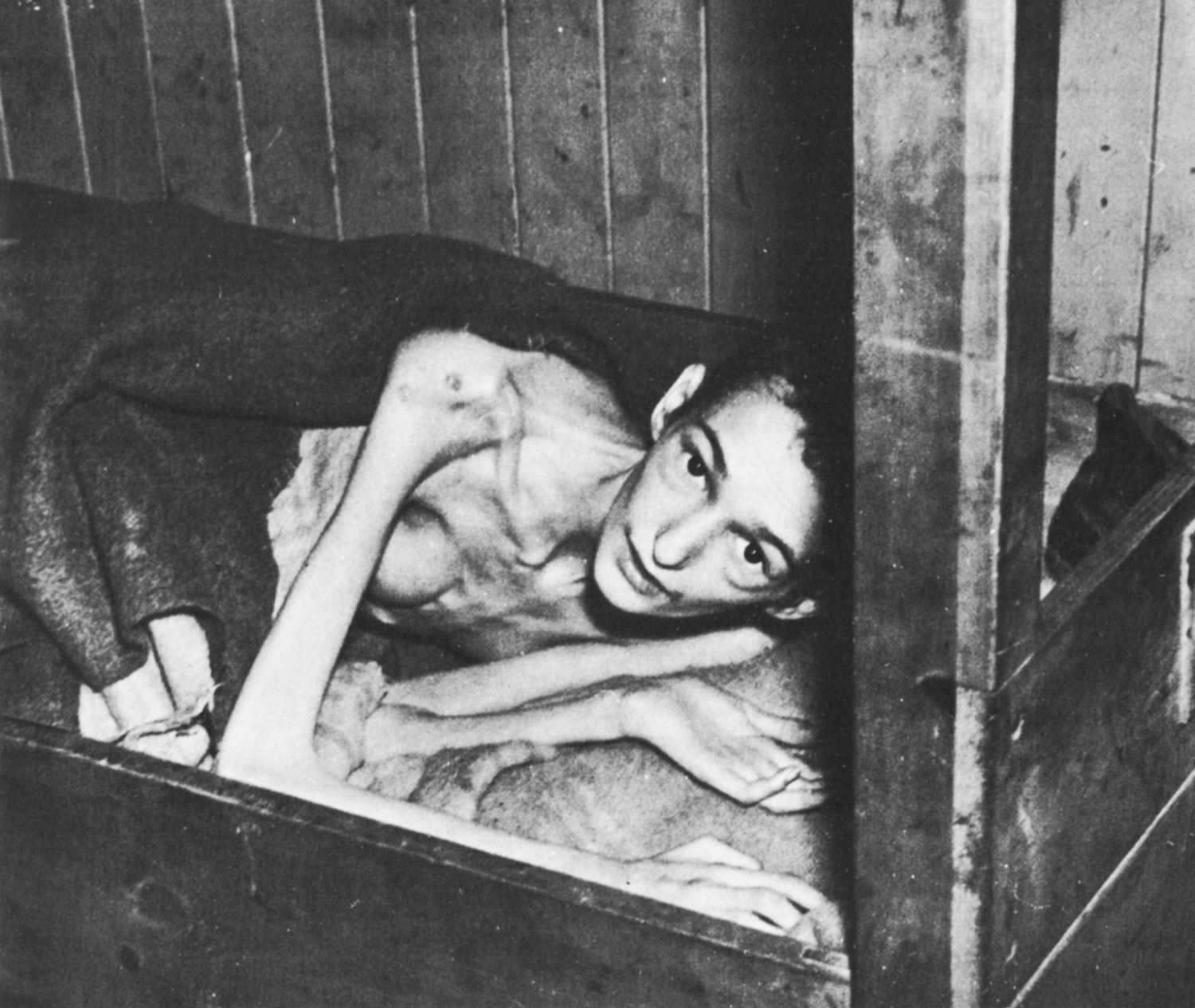
I have always had a feeling that the year 1945 was a turning point in Richard’s life. It was the year in which he saw Belsen, and, as for so many of us, the world could never be quite the same after that outrage to human decency. And Richard was with the first party to go in.
It was a strange and frightening spring for the BBC war correspondents. We had covered the crossing of the Rhine, the last of the big battle set-pieces of the war, and the last occasion when we had to carry the microphone into the front line. I remember trying to do a commentary in the leading Buffalo assault craft as we plunged across the river at night, while next morning Richard was with the gliders that came through a furious storm of flak to make the biggest airborne landing ever staged by the allies. We met on the ground not long afterwards and I remember Richard saying to me, ‘I don’t think I want to see much more of war. I’ve had five years of reporting it and that’s enough for any man.’ I admitted that I had also lost my keenness for front line reporting – in 1945 the end seemed in sight and no one wants to take risks in the last minutes of a battle.
Besides, we were now driving fast through Northern Germany and we were beginning to uncover some of the grim secrets that the Nazis had been guarding for so long – party headquarters with secret documents of the treatment of political opponents, propaganda centres full of the mad fantasies of the Third Reich, forced labour camps with starving Russian prisoners-of-war. But so far we had not found traces of the most notorious of the Nazi crimes against humanity, the concentration camps, the mysterious places to which men and women were spirited away, where they were beaten, tortured, killed for the sole crime of being Jews, Poles, Gypsies, or for not believing in the mad vision of Adolf Hitler. We wondered if the stories about them had been exaggerated. After all, released prisoners tend to play for sympathy and surely not even the Nazis could descend to the depths these stories indicated.
Then, on an April morning which had a deceptive promise of warmth in the air, a rumour reached the press centre; our advancing troops had heard that ahead of them there was a camp at which typhus had broken out and they were pushing out a flying column, equipped with medical supplies, to contact the prisoners. Richard always had the good newsman’s flair for sensing a story. I admit I thought the camp was going to be a normal prisoner-of-war one, and for the last few weeks we’d liberated scores of them. ‘Nothing new here,’ I said to Richard, ‘I’ll come up later.’
When next I met Richard he was a changed man. I spotted his jeep coming down through a narrow road amongst the gloomy pine woods that dot the level North German plain. There was rain in the air and the whole atmosphere of the place seemed dank, depressing. Richard got out and said to me at once, ‘It’s horrible; human beings have no right to do this to each other. You must go and see it, but you’ll never wash the smell of it off your hands, never get the filth of it out of your mind. I’ve just made a decision. … I must tell the exact truth, every detail of it, even if people don’t believe me, even if they feel these things should not be told. This is an outrage … an outrage.’
I had never seen Richard so moved. Until then I had always regarded Richard as a man who would never let his feelings show through his utterly professional surface efficiency. But here was a new Dimbleby, a fundamentally decent man who had seen something really evil, and hated it with all his strength. Did the memory of what he saw at Belsen lie at the back of his mind and give his commentaries on great occasions, his appeals on radio and television, a feeling for the suffering and anxieties of others which was instantly perceived by the viewer? I think it did.
I went on up that dismal road and turned down the sandy track through the pine woods that led to the gates of Belsen. What we saw and felt then is best expressed in the words of the most moving despatch Richard Dimbleby ever broadcast for the BBC:
When I returned from Washington to take over charge of the Television Talks Department at the beginning of 1954 I was intent on developing television journalism. My department had some lively young producers, one of whom was Michael Peacock:
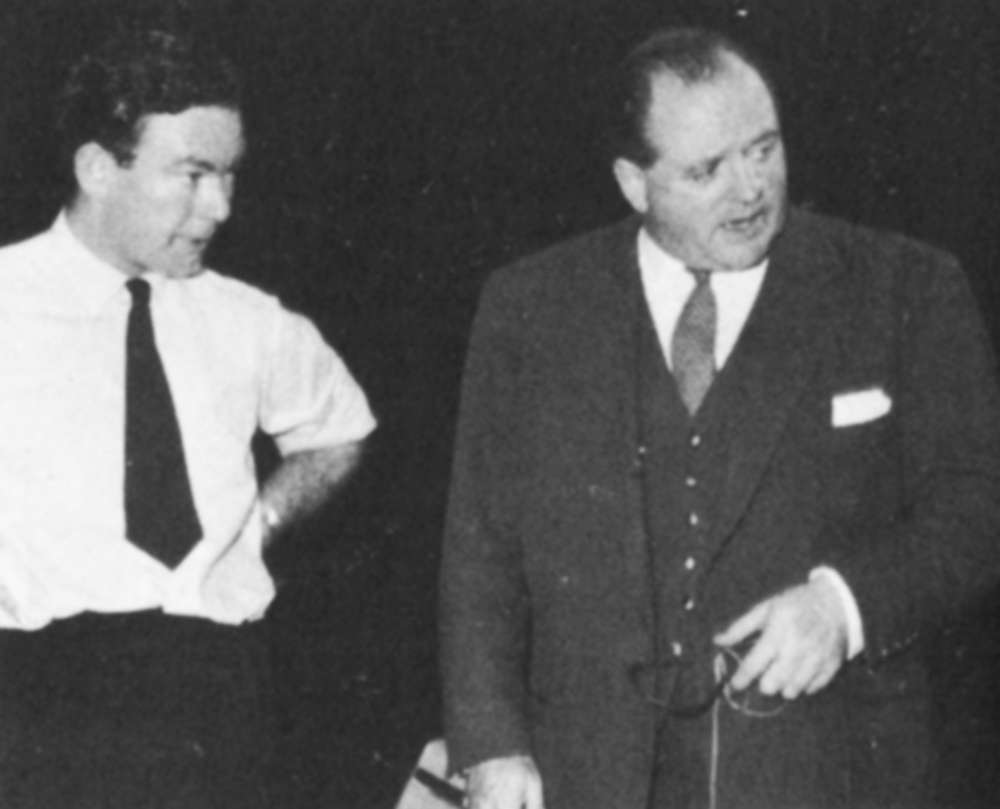
Panorama from Bristol with Michael Peacock, 31 October 1960
It all began, for me at least, in May 1954. At that time I was 24 and had had only eighteen months’ experience of television. Richard Dimbleby was no more than a name to me. I admired his work, but had never met him. He worked on Outside Broadcasts and on About Britain, produced by the Documentary Department. I worked in Television Talks Department, which until then had never used Richard. Our paths had never crossed.
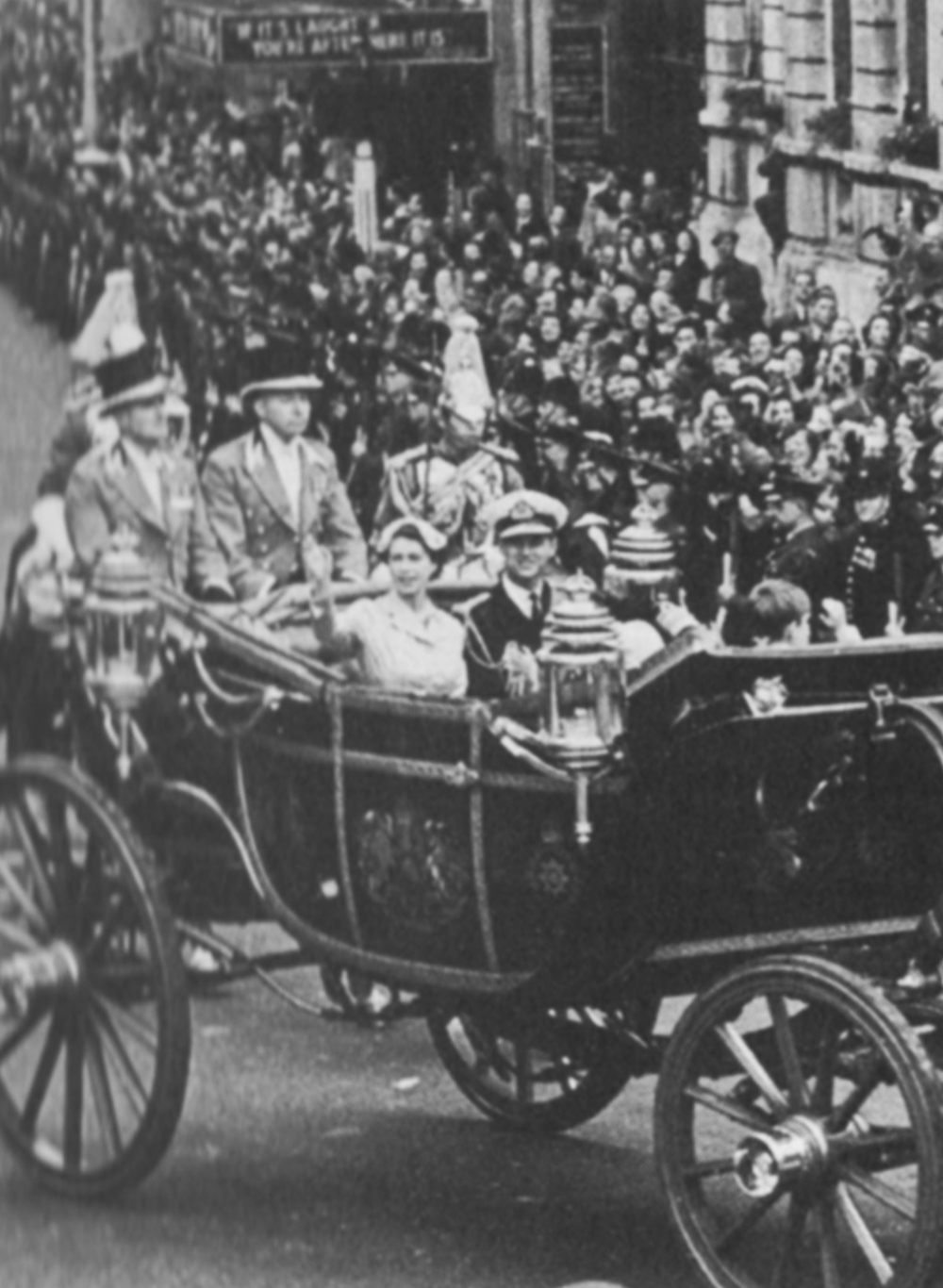
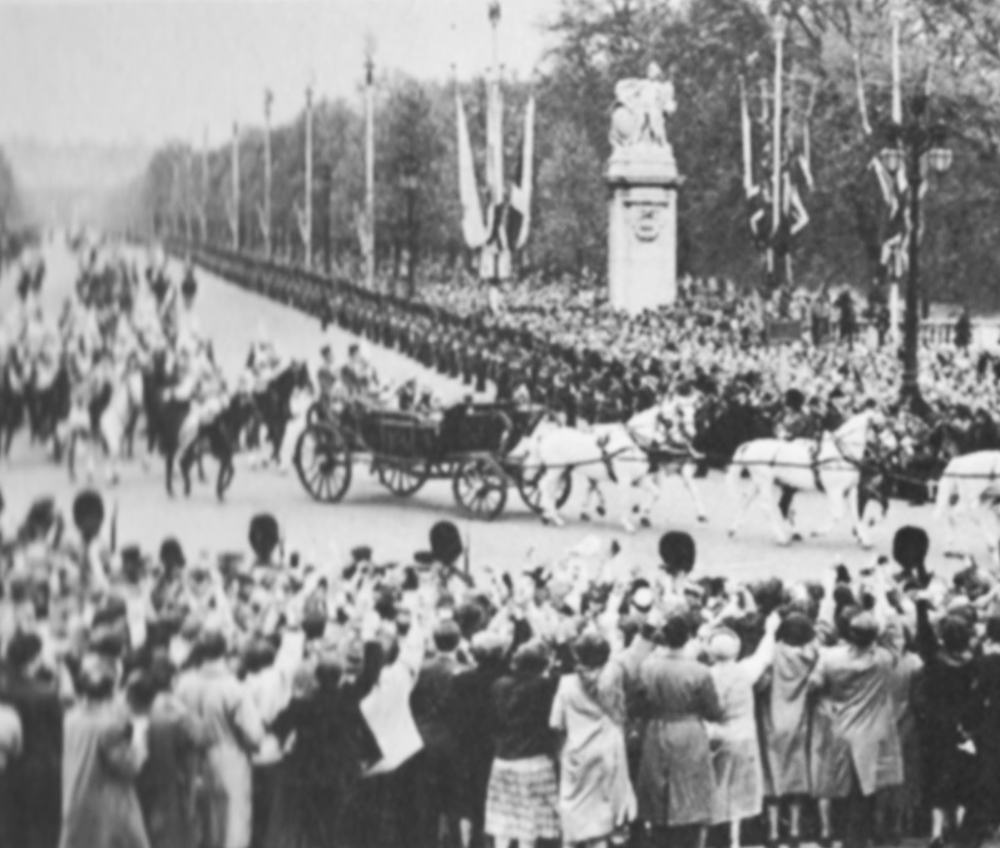
The Queen’s World Tour was due to finish on 15 May of that year. One afternoon ten days before, Cecil McGivern, our Controller of Television Programmes, was summoned from his Lime Grove office to Broadcasting House. A meeting had been called to co-ordinate radio and television plans for covering the Queen’s return to London. One by one the Outside Broadcasts for each stage of the Queen’s arrival were noted and checked. Richard Dimbleby, who was reporting the Mediterranean part of the tour for radio, would leave Britannia at Gibraltar and fly ahead to London, arriving the day before. He would then give the television commentary for what would be a great State occasion which our cameras would cover throughout from Britannia‘s arrival in the Pool of London to the Queen’s drive home to Buckingham Palace.
To Cecil’s surprise the meeting went on to consider the programmes arranged for the evening of 15 May in which the full story of this historic Royal Tour would be told. Those were days of a certain rivalry and jockeying for position between radio and television. The Television Service had in fact no plans for any programme beyond the Outside Broadcast of the Queen’s drive through London. Cecil McGivern heard the scale of radio’s plans for recapitulating the Queen’s journey. Undaunted he calmly announced that the Television Service would also be mounting an evening programme to celebrate the Queen’s return and asked how many of the BBC’s News Correspondents who had reported the tour could be made available.
The meeting was soon over, and Cecil leapt to a telephone. It was a Radio Times Press Day, but the page for 15 May was held in the nick of time. At about 5 p.m. that day I was summoned to Cecil’s office. With him I found Grace Wyndham Goldie, my immediate boss, and Joanna Spicer, his programme planner. The situation was explained to me. I was to produce ‘Postcript to the Journey’, as the programme had been christened, at 7.55 p.m. on 15 May. It would last forty minutes. The Archbishop of Canterbury had agreed to take part. Godfrey Talbot, Audrey Russell and Wynford Vaughan-Thomas would be available. Richard Dimbleby had agreed to be the anchorman. Television Newsreel had undertaken to provide film of the Queen’s tour, and there was the possibility of the Commonwealth High Commissioners in London each contributing a message for the programme. ‘This is a very important programme for the Television Service’, said Cecil meaningfully. I had my marching orders!
For me there followed nine days of gruelling and hectic work, at the end of which I had concocted a very complicated and elaborate programme involving live radio circuits to most of the countries visited by the Queen, a dozen or more film sequences which would have to be commentated ‘live’, reports from News correspondents who had little or no experience of television, the Archbishop and the High Commissioners, and edited telerecordings of the Outside Broadcasts earlier in the day.
The afternoon of the day before, the script was finished, and at 5 o’clock Richard Dimbleby, just back from Gibraltar, climbed for the first time the narrow stairs up to my office in what had been an attic bedroom in one of the houses adjoining the Lime Grove Studios. He was to climb those stairs countless times during the next ten years, for the Panorama office is there to this day.
He came into the room a little warily, his smile taking in the faces he didn’t know. We shook hands self-consciously, and after some small talk I gave him a copy of the script. He laughed at its weight and settled down to go through it with me. As the scope and complexity of the programme became apparent to him, he looked at me quizzically. ‘You’ve got yourself a handful here’, he said, obviously wondering whether this young man whom he had never met before was going to land him in a technical shambles the following evening.
For the next two hours we went through every detail of the programme. This was my first experience of Richard at work, and it was an eye-opener. Even now, I remember the quickness with which he took my points, and his uncanny ability to see where things might go wrong, and the painstaking way with which he noted down what he had to do or might have to do. At the end of our session his script was covered with notes, and he knew everything there was to know about the programme. I was exhausted, and perhaps he sensed this; for as he stood up to leave, he put his arm on my shoulder and grinned cheerfully. ‘Don’t worry,’ he said, ‘it will work all right on the night – provided we hit those telecine cues.’ ‘It should be a very good programme,’ he added kindly. ‘See you at about 5 o’clock tomorrow’. And off he went.
In the event, it was a very good programme – thanks to Richard. When radio circuits failed he switched faultlessly into the standby routines worked out the night before. He produced immaculate unscripted commentaries to the edited telerecordings he had not seen before. He hit cue after cue as he promised he would, and kept his head when a large and very heavy camera dolly ran over the foot of the unfortunate studio manager during an unrehearsed tracking shot at the end of the programme (the studio manager was an unsung hero – he didn’t even cry out despite a broken bone!).
After this programme it was inevitable that we should ask Richard to be anchorman for the 1955 General Election Results Programme. Then, he showed us all not only his unique skill, but also his extraordinary stamina. Despite a gruelling day of rehearsals while people were voting, he worked in front of the cameras until dawn. He had a couple of hours off to catch a moment of sleep, then opened the programme again well before breakfast with the words, ‘Short night, wasn’t it’, kept going non-stop throughout the following day, and then finished off his two-day stint with the big round-up programme on the Friday evening, which included a well-deserved bouquet from his old friend and wartime colleague Ed Murrow.
General Election 1959
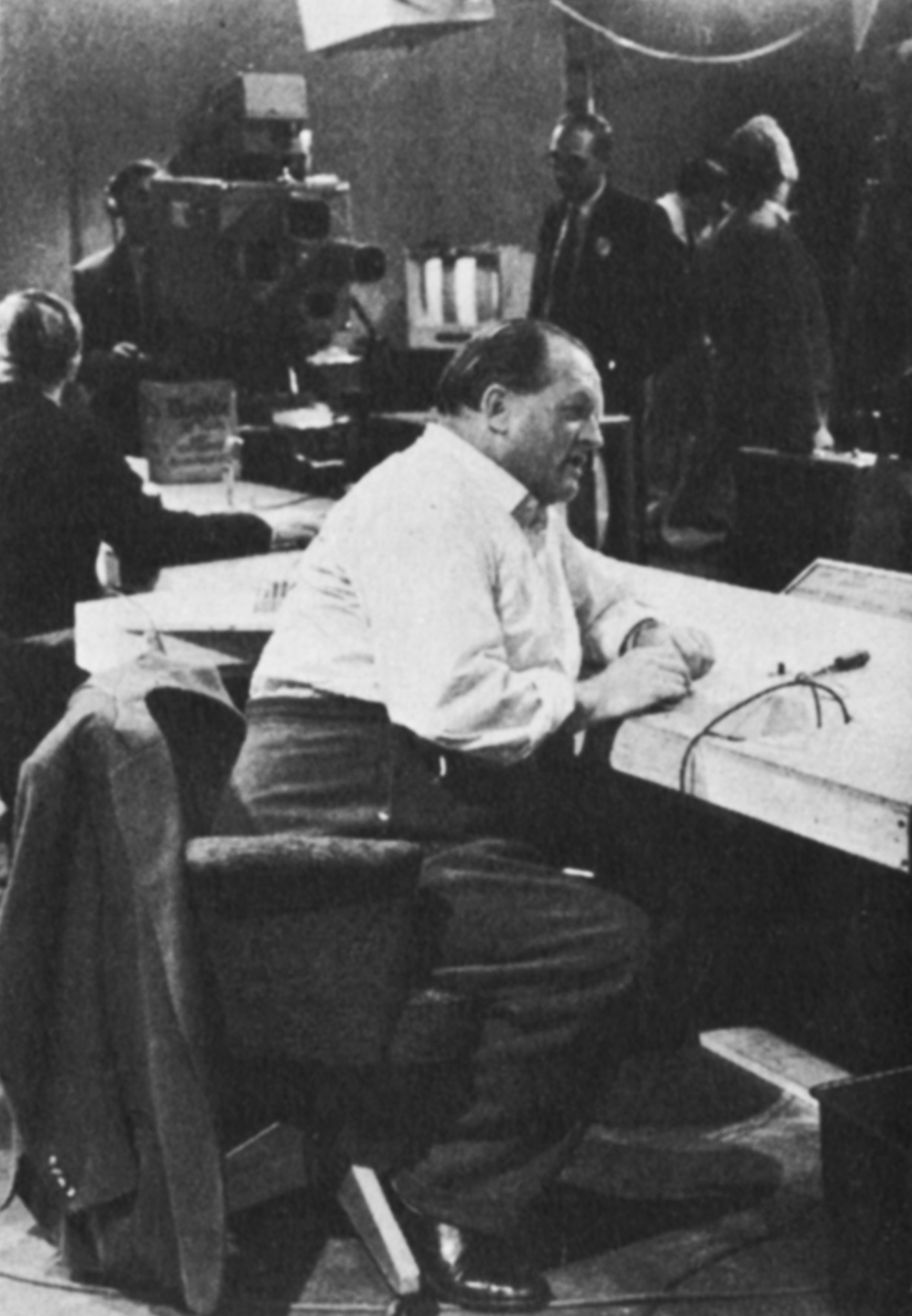
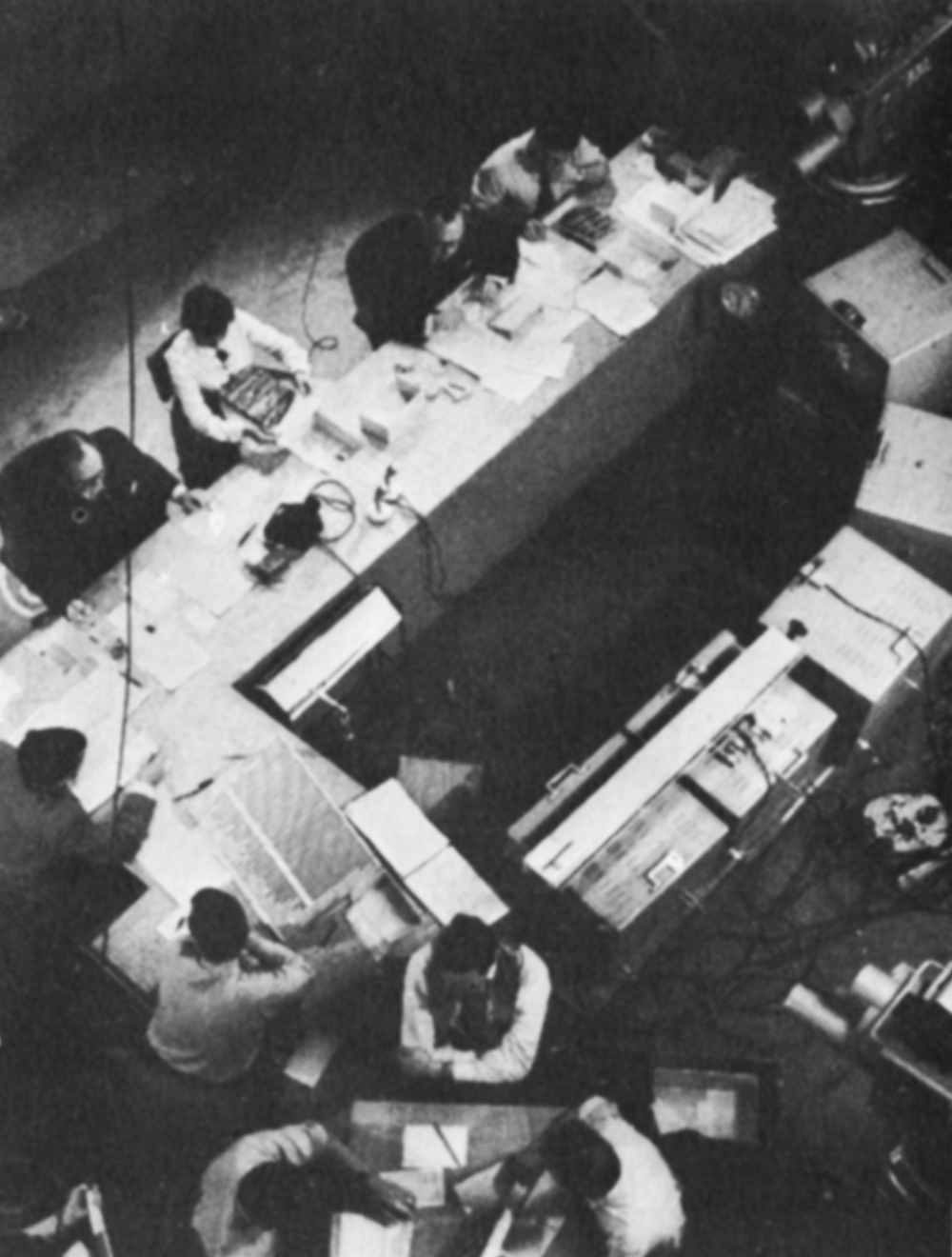
Richard Dimbleby’s election marathons were to become world famous. The secret of his extraordinary command of the situation during these very complicated and exacting programmes lay in the card index of information about each constituency which was prepared for him beforehand. In 1959 the preparation of this index went badly wrong. On the Tuesday before Election Thursday it was not finished, and those cards which had been prepared were incorrect. Richard took off his coat and lived with the index from then on, going through each constituency card with Stanley Hyland who was drafted in to help. Together they worked right through the Wednesday night. So in 1959 he had no sleep the night before he began his marathon. An extraordinary man!
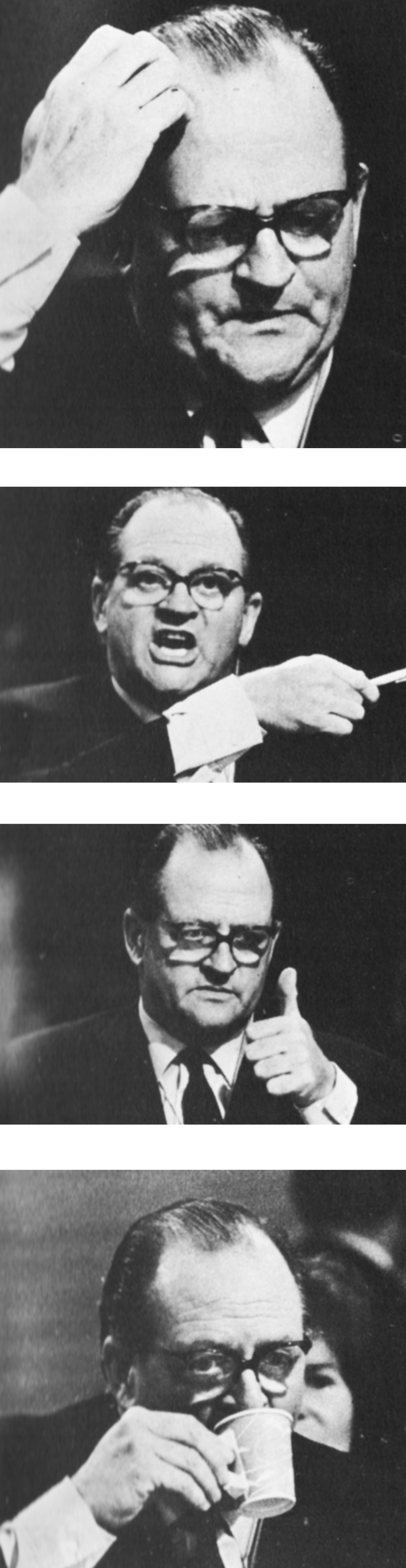
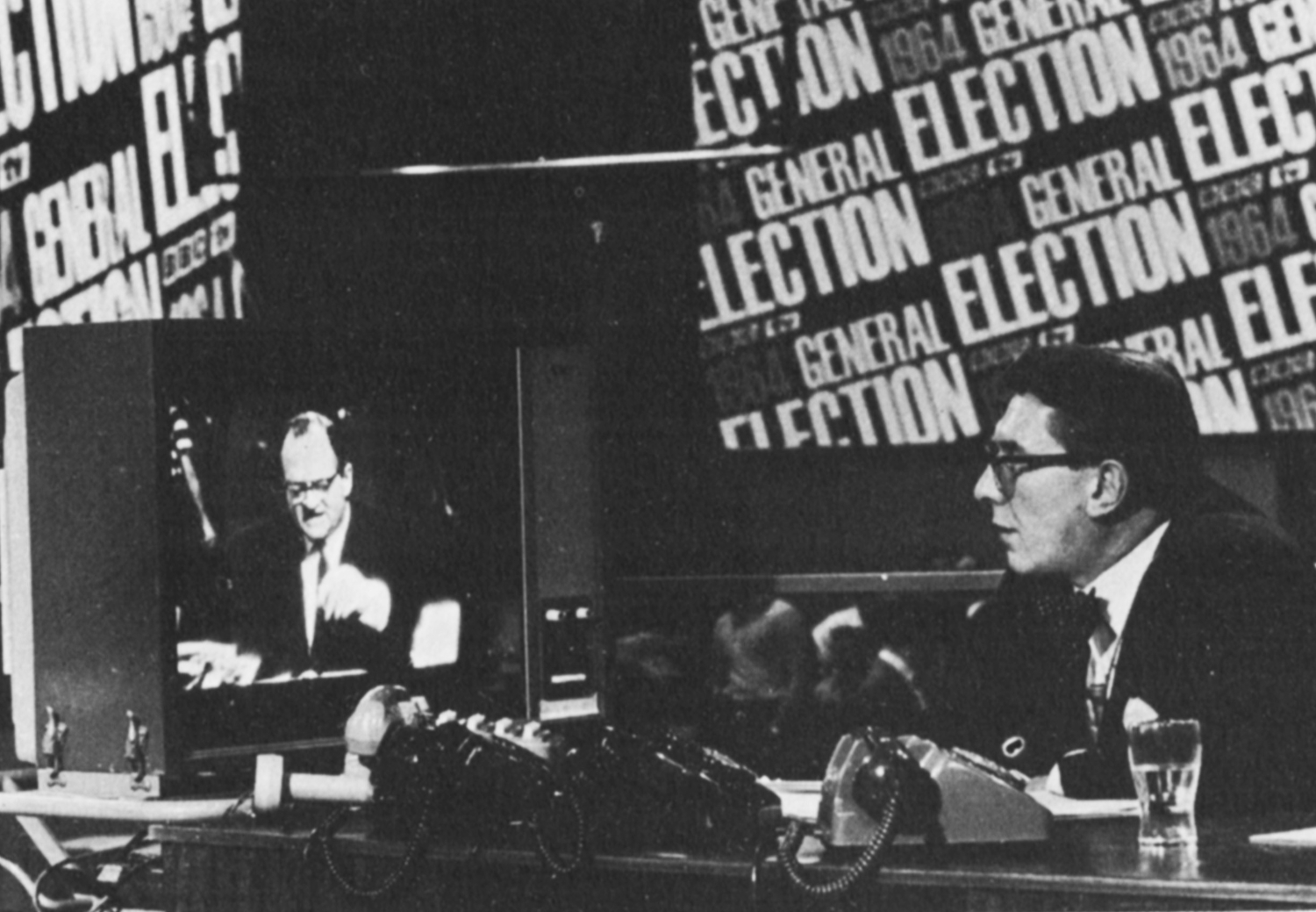
His last General Election marathon was in October 1964, by which time he had been suffering from cancer for four and a half years. And yet he would not even listen to a hint that he might have a rest in the early hours of the Friday morning. Not a bit of it! And never had I seen him more at ease, more on top of his job, more the life and soul of the programme than during the 1964 Election Results which began with an unexpected curtain raiser in the form of Khrushchev’s fall from power. Do you remember George Brown crossing swords with Robin Day in a memorable interview on the Friday afternoon when the tension was almost intolerable and tempers were getting frayed? ‘And a Merry Christmas to all our readers!’ said Richard as cameras switched back to him. The tension dropped and the programme rolled on.
It was after the 1955 Election Results programme that the idea of a weekly Panorama with Richard Dimbleby as anchorman was born. In September 1955, because of the illness of my co-producer, I found myself in sole charge of what was to become the BBC’s most important regular programme. With Richard Dimbleby and with Malcolm Muggeridge, Woodrow Wyatt, Max Robertson and, six months later, with Chris Chataway, we set out to explore the virgin lands of weekly television journalism.
General Election 1964
For Richard, the years of preparation were over. At last he had a weekly major current affairs programme of his own. At last his skills as a newsman, reporter, commentator, and television professional could come together and find expression in one programme.
I worked with Richard on Panorama for four years in all. Memory can be deceptive, but for me Panorama’s finest hour will always be the autumn of 1956. It was during those dark weeks of the Hungarian revolution and the Suez invasion that Panorama grew up. The programme with Richard became a national institution. Thinking back now, my memories of Panorama during that troubled time are blurred and confused. Nasser, the Suez Canal, Budapest, Refugees, Cyprus, Eden, Eisenhower and Stevenson, Khrushchev, the Gaza Strip, Port Said, the United Nations … our cameras rolled, our voices strained, our typewriters tore into paper, as each Monday Richard Dimbleby reported the continuing crisis in Panorama.
Inevitably, Richard wanted to report these great events at first hand. But an anchorman is an anchorman, and we needed him in the Panorama studio. However, he did get to Vienna during this period to report the plight of the thousands of Hungarian refugees who were pouring into the city. As fate would have it, we could not get our Eurovision pictures through from Vienna that Monday night, and for the first time Richard couldn’t introduce Panorama. Cliff Michelmore, who happened to be in the building, took his place. Half an hour later we had used up all our standby material, and Malcolm Muggeridge and some experts on Russia in the Lime Grove Studio were clearly reaching the end of what they could find to say about Khrushchev. It looked as if we might have to end the programme early without switching to Vienna at all.
We had an open control line to the Austrian Outside Broadcast Unit. Richard came on the line. ‘Mike,’ he said, ‘don’t give up. The pictures must come through soon. We must do this Outside Broadcast. It means so much to these people. For them to lose this chance to tell their story to the world would be a tragedy. Their story is all they have left.’
Two minutes later the Eurovision picture we had been waiting for flickered on to our monitors in the Lime Grove Studio. Within thirty seconds we had switched to Vienna and heard his familiar voice: “This is Richard Dimbleby reporting for Panorama from Vienna, where tonight….’ We’d made it, and for the next twenty minutes he helped those Hungarian refugees tell their story to the world.
That is how I shall always remember Richard. A born reporter: full of heart and compassion; moved to action by the plight of the refugees, the homeless, the hungry; determined that their story should be told.
After the final hymn the fabric of the Abbey rang as the BBC Symphony Orchestra, conducted by Sir Adrian Boult, played ‘Nimrod’ from Elgar’s ‘Enigma Variations’. It fell to Wynford Vaughan-Thomas, fellow war correspondent and lifelong friend, to give the closing commentary to the last Richard Dimbleby broadcast:
The service in the Abbey has been the public commemoration of Richard Dimbleby. May we who worked so long with him, the cameras and microphones now backstage, now say our farewell to the man we knew as the finest professional of us all. Ours is a transient art; our words and pictures make a powerful immediate impact, and then fade as if they had never been. But Richard brought a sense of permanence to our impermanent profession. We knew him as a simple man, a good man, and in the end a very brave man. He gave warmth to the spoken word, friendliness to the formal occasion, and tradition and dignity to the whole new world of broadcasting. We shall not easily forget him.